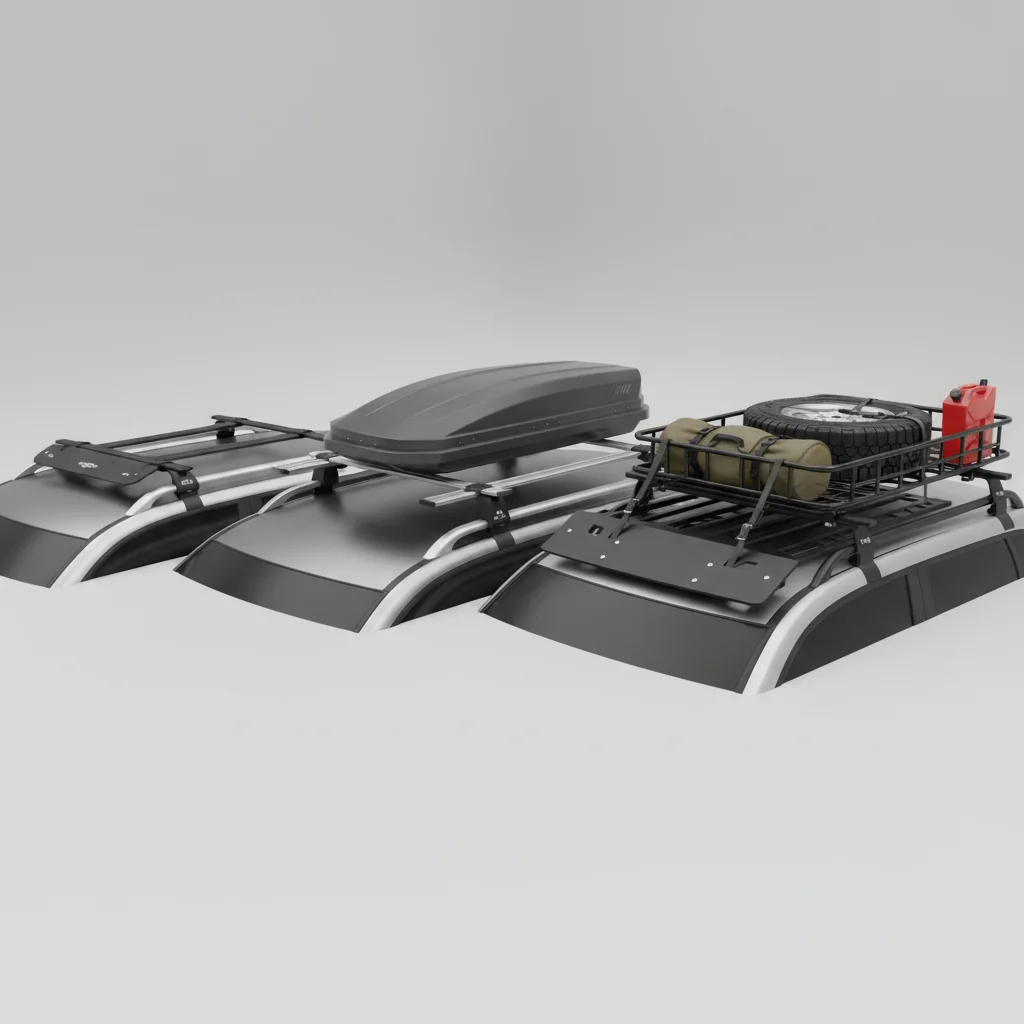
Choosing the right roof rack type is crucial for safely transporting gear and maximizing your vehicle’s utility. There are five primary roof rack types, each designed to fit different vehicle roof styles and carry specific loads. Understanding these distinctions will help you select the most effective and secure system for your adventures.
Understanding Bare Roof Systems
Bare roof systems are designed for vehicles that do not have any pre-installed rails, tracks, or fixed points. These systems typically use clamps that grip the door frame of your vehicle. Installation involves carefully positioning the towers and crossbars, ensuring a secure fit without damaging the paintwork or weather stripping. While offering great versatility for vehicles without factory-installed options, it’s essential to verify compatibility with your specific make and model to ensure a safe and stable attachment. For automotive roof buying guides on this site.
Raised Rail Roof Racks Explained
Raised rail roof racks are among the most common types, identifiable by rails that run front-to-back along the roof, with a gap between the rail and the roof itself. These systems are popular due to their ease of installation and removal. Towers clamp directly onto the raised rails, providing a strong and stable base for crossbars. This design is ideal for a wide range of vehicles, including many SUVs, wagons, and minivans, offering a robust solution for carrying bikes, kayaks, or cargo boxes.
Flush Rail and Fixed Point Systems
Flush rail systems feature rails that sit directly on the roof, without a gap, creating a sleek, integrated look. Fixed point systems, on the other hand, have specific, often covered, attachment points built into the vehicle’s roof by the manufacturer. Both require specific towers that integrate precisely with these factory-designed features. These systems offer a very clean aesthetic and often superior aerodynamics, as the rack sits closer to the vehicle’s roof. They are known for their strong, secure attachment, making them excellent for heavier loads or high-speed travel.
Gutter Mount Roof Racks for Older Vehicles
Gutter mount roof racks are a classic design, primarily used on older vehicles, vans, or vehicles with rain gutters. These systems attach directly to the vehicle’s rain gutters, providing a very strong and reliable mounting point. While less common on modern passenger cars, they remain a popular choice for utility vehicles and those seeking maximum load capacity. The robust nature of gutter mounts makes them suitable for heavy-duty applications, such as carrying ladders or large equipment.
Track Mount Systems for Customization
Track mount systems involve installing tracks directly onto the vehicle’s roof, often requiring drilling. Once installed, these tracks allow for highly customizable crossbar positioning, as the towers can slide along the track to accommodate different load sizes or types. This flexibility makes them a favorite for adventurers who need to adjust their setup frequently, or for vehicles where other roof rack types are not suitable. They offer a semi-permanent solution with excellent versatility.
Key Considerations When Choosing Your Roof Rack
|
Our Picks for the Best Roof Rack in 2026
As an Amazon Associate I earn from qualifying purchases.
|
||
| Num | Product | Action |
|---|---|---|
| 1 | GarveeLife 51 in x 36 in Universal Roof Rack Basket, 200 LBS Capacity Rooftop Cargo Carrier Basket, Heavy Duty Luggage Holder Rack for SUVs, Trucks, Vehicles |

|
| 2 | 64 x 39 x 6 Inch Roof Rack Basket, Heavy Duty 300LB Car Roof Rack Universal Cargo Carrier Rooftop Cargo Basket Steel Luggage Holder for SUV, Truck & Pickup |
|
| 3 | MaxxHaul Steel Roof Rack Cargo Basket, 46" x 36" x 4.5" Roof Top Carrier, Universal Fit for Cars, SUVs, Vans, and RVs, 150 lb Capacity, Weather-Resistant Easy-Install Cargo Storage (70115) |
|
| 4 | MAXXHAUL 50506 64" x 39" x 6" Heavy-Duty Universal Steel Roof Rack , Black |
|
| 5 | munirater Universal 43.3 inch Black Roof Rack Cross Bar Top Luggage Aluminum Carrier Adjustable Window Frame 2Pcs |
|
| 6 | MeeFar Roof Rack Carrier Basket Universal Rooftop 51" X 36" X 5" + Waterproof Bag 15 Cubic Feet (44" 34" 17"), and Cargo Net with Attachment Hooks, Ratchet Straps |
|
| 7 | GarveeLife 51 in x 36 in Universal Roof Rack Carrier Basket, 200 LBS Capacity Rooftop Cargo Rack, Car Top Luggage Holder Basket Heavy Duty for SUVs, Trucks, Vehicles |
|
| 8 | GarveeLife 46" x 36" Universal Roof Rack Cargo Carrier Basket, 200 Lbs Capacity Rooftop Cargo Rack, Car Top Luggage Holder Basket Heavy Duty for SUVs, Trucks, Vehicles |
|
| 9 | KitsPro 260lb Roof Rack Cross Bars for 2011-2021 Jeep Grand Cherokee (ONLY FIT Factory Grooved Side Rails), Matte Black Heavy Duty Aluminum Cargo Crossbar |
|
| 10 | Auto Dynasty Roof Rack Cross Bars Compatible with 2014-2018 Acura MDX, 165lbs Rooftop Cargo Bars Aluminum Anti-Corrosion Bolt-On Roof Rails for Luggage Bike Kayak Racks |
|
- Vehicle Compatibility: Always check the manufacturer’s fit guide for your specific make, model, and year.
- Load Capacity: Understand both the roof rack’s and your vehicle’s maximum weight limits.
- Intended Use: Consider what you’ll be carrying (bikes, kayaks, cargo boxes, skis) to ensure the system can accommodate it.
- Installation Difficulty: Some systems are easier to install than others; consider if you prefer DIY or professional installation.
- Aerodynamics and Noise: Different designs can impact fuel efficiency and wind noise; fairings can help mitigate this.

We needed a solution for our kayaks and were debating between a few options. The explanation of fixed point systems really helped us decide. We ended up getting one for our Subaru Outback, and it’s been fantastic for hauling our gear to the lake. My only minor complaint is that the wind noise is a bit more noticeable at highway speeds than I expected, but it’s not a dealbreaker.
I’ve always struggled with fitting all my camping gear inside my sedan, especially with the kids. After reading about the different roof rack types, I went with a bare roof system for my Honda Civic. Installation was surprisingly straightforward, and it feels incredibly secure. It’s made a huge difference for our weekend trips, freeing up so much space inside the car.
This was super helpful in understanding the different options. I have a vehicle with raised rails, and I was able to easily pick out the right crossbar system. It was a breeze to install, and now I can finally transport my paddleboard without having to borrow a friend’s truck. Definitely recommend doing your research on the types before buying.
I was looking for something to carry my mountain bike and thought a gutter mount system would be perfect for my older SUV. While it does the job, getting the clamps perfectly aligned took a lot more fiddling than I anticipated. It feels sturdy once it’s on, but the initial setup was a bit of a pain. I wish the instructions were a little clearer on the exact positioning.