Safely securing kayaks to your roof rack for any adventure involves using the right equipment and following a precise step-by-step method to prevent damage and ensure road safety. The process includes selecting appropriate carrier systems like J-cradles or saddle systems, using high-quality cam buckle straps, and always incorporating bow and stern lines for stability. This comprehensive guide details essential gear, provides step-by-step instructions, and outlines crucial safety checks to confidently transport your kayak.
Why Proper Kayak Securing on Your Roof Rack is Crucial
Transporting a kayak, whether for a short trip to the local lake or a long haul across states, demands meticulous attention to detail. Ignoring proper securing protocols isn’t just an inconvenience; it can have severe consequences. Imagine your kayak becoming dislodged at highway speeds, posing a significant hazard to other drivers and potentially causing serious accidents. Beyond the obvious safety risks, a poorly secured kayak can incur costly damage to your vehicle’s roof, the kayak itself, or other gear. High winds, sharp turns, and sudden stops can all test the integrity of your tie-down system, highlighting why investing time in learning and implementing correct techniques is paramount. Adhering to local transportation laws often requires all loads to be properly secured, making it a legal as well as a practical necessity. By mastering the art of safe kayak transport, you safeguard lives, protect your investments, and ensure every trip begins and ends without a hitch.
Essential Gear for Secure Kayak Transport
Before you even think about lifting your kayak onto your vehicle, assembling the right equipment is key to a safe and hassle-free transport experience. The foundation of any robust kayak carrying system begins with a solid roof rack. While soft racks offer a convenient, temporary solution, especially for vehicles without permanent fixtures, a rigid-bar roof rack system generally provides the most stable and reliable platform for regular kayak transport. These systems typically consist of two crossbars that span the width of your vehicle, attaching to factory-installed side rails, door frames, or specific mounting points. For compare top automotive roof on this site.
Beyond the basic crossbars, specialized kayak carrier systems are designed to cradle your boat more effectively, offering enhanced security and protection. J-cradles hold the kayak on its side, optimizing aerodynamics and often allowing space for a second kayak or other gear. Saddle systems provide broad, cushioned support for the kayak’s hull, distributing weight evenly. For those looking to transport multiple kayaks, stacker bars allow boats to be stacked vertically on their sides, making efficient use of roof space.
The unsung heroes of kayak transport are high-quality tie-downs. Cam buckle straps are the go-to choice for their ease of use and ability to cinch tightly without the risk of overtightening. It’s crucial to select straps that are long enough (typically 12 feet or more) and made from durable, weather-resistant material. A common mistake is to use ratchet straps, which, while seemingly robust, can apply excessive force and potentially damage or deform a plastic kayak hull, or even crack fiberglass.
Finally, bow and stern lines are non-negotiable for longer kayaks, highway travel, or high wind conditions. These lines provide crucial stability, preventing the kayak from lifting at the ends due to aerodynamic forces or shifting forward and backward during sudden braking or acceleration. They typically attach from the kayak’s grab handles to secure points on your vehicle’s front and rear, such as tow hooks or hood/trunk loop straps. Always carry spare straps; you never know when one might wear out or when you might need an extra tie-down.
Comparing Kayak Carrier Systems
Choosing the right kayak carrier system depends on several factors: the type and number of kayaks you own, your vehicle type, ease of loading, and budget. Each system offers distinct advantages and disadvantages, impacting both security and convenience. Understanding these differences will help you make an informed decision for your specific needs.
| Kayak Carrier Type | Advantages | Disadvantages | Estimated Price Range (USD) |
|---|---|---|---|
| Crossbars (Directly) | Most affordable entry point, simple setup, versatile for various gear | Kayak hull can dent without padding, less lateral stability, takes up full roof width | $50 – $200 (for padding/basic straps) |
| J-Cradles | Excellent hull support, keeps kayak on its side for better aerodynamics, frees up roof space for a second kayak | Can be difficult for solo loading, takes up significant crossbar width, kayaks exposed to elements | $100 – $300 |
| Saddle/Roller Systems | Easiest for solo loading (especially with rollers), superior hull protection, good stability | Higher cost, may require specific kayak hull shapes, often wider than J-cradles | $150 – $400 |
| Stacker Bars | Ideal for transporting multiple kayaks (2-4), maximizes roof space, compact when not in use | Kayaks are fully exposed to elements, requires more straps, can be challenging to load taller boats | $80 – $250 |
| Foam Blocks | Inexpensive, portable, no permanent rack needed, good for occasional use on bare roofs | Less secure for long distances or high speeds, can shift, potential for vehicle paint damage, low weight capacity | $20 – $50 |
While directly placing a kayak on padded crossbars is the simplest method, dedicated carriers like J-cradles or saddles offer enhanced stability and protection. Stacker bars are a major upgrade for group outings, allowing multiple boats to be carried efficiently. Foam blocks are a budget-friendly option for short, infrequent trips without an existing roof rack, though they require careful securing directly through the vehicle’s doors or windows. Regardless of the system, always verify it’s compatible with your specific kayak and vehicle, and never exceed the manufacturer’s stated weight limits for both your roof rack and vehicle roof.
Preparing Your Kayak and Vehicle for Transport
A well-prepared setup is the foundation of secure kayak transport. Before you even lift your kayak, ensure your vehicle is ready. Start by checking your roof rack’s installation; crossbars should be firmly attached and correctly spaced according to your rack system’s recommendations. For most kayaks, positioning the crossbars so they are roughly 24-36 inches apart provides optimal support. Always consult your vehicle’s owner’s manual for its maximum roof load capacity and ensure your roof rack system is rated to handle the weight of your kayak(s) and any additional gear.
Next, prepare your kayak. Remove any loose items from the cockpit, such as paddles, life jackets, or dry bags, and store them securely inside your vehicle. This prevents them from flying off during transit and reduces overall weight on the roof. If your kayak has a drain plug, ensure it’s securely fastened to prevent water from entering the hull if you encounter rain.
When positioning the kayak, most experts recommend placing it upside down (hull-up) on the crossbars. This orientation offers several benefits: it protects the delicate hull from road grime and potential damage, prevents water from accumulating inside the cockpit during rain, and can improve aerodynamics, reducing wind noise and drag. However, some modern whitewater kayaks or those with unique deck shapes might sit better upright. If transporting hull-up, consider using specialized cradle pads or thick foam blocks on your crossbars to protect the kayak’s hull from denting or “oil-canning” due to pressure from the straps. If using a J-cradle or stacker system, simply follow their specific loading instructions. Finally, ensure the kayak is centered fore and aft on your roof rack, running parallel to your vehicle. This even weight distribution is vital for vehicle handling and stability.
Step-by-Step Guide to Securing Your Kayak
Once your kayak is positioned and your gear is ready, it’s time to secure it. This DIY process is straightforward but requires careful attention to each step to guarantee maximum safety.
1. Position Your Kayak on the Roof Rack: Carefully lift your kayak onto your vehicle’s crossbars or specialized carrier system. Ensure it is centered both from front to back and side to side, running parallel to your car. If using a J-cradle or stacker, confirm the kayak is seated correctly within the supports. If placing it directly on crossbars, make sure it’s hull-up and sitting on adequate padding.
2. Prepare Your Cam Straps: You’ll need at least two cam buckle straps, one for each crossbar. Start by positioning the buckle end of the first strap on one side of your kayak, a few inches above and to the side of the front crossbar. This placement keeps the buckle from rubbing against your vehicle’s paint and makes it accessible for tightening. Toss the free end of the strap over the kayak to the other side of your vehicle.
3. Loop and Feed the Straps: Walk to the other side of your vehicle, grab the free end of the strap, and loop it underneath the crossbar. It’s crucial to loop the strap inside where the crossbar attaches to the vehicle’s towers; this prevents the strap from sliding off the end of the crossbar. Now, toss the strap end back over the kayak. Return to the side where the buckle is, loop the strap underneath the crossbar again (also inside the tower), and feed the free end into the cam buckle. Repeat this entire process for the second strap at the rear crossbar.
4. Cinch Down the Straps: With both straps threaded, gently pull the free end of each strap through its cam buckle to tighten. Work back and forth between the front and rear straps, gradually increasing tension. The goal is for the kayak to be snug and secure, without any movement, but not so tight that it deforms the kayak’s hull or causes flexing. Overtightening can cause permanent damage, especially to plastic boats. A good rule of thumb is that you shouldn’t be able to easily shift the kayak by hand once tightened. To minimize annoying strap vibration (humming) during highway driving, add a single twist to each strap as it crosses over the kayak.
5. Secure Bow and Stern Lines: This step is vital for preventing lift and fore/aft movement. Attach one end of a bow line to the front grab handle or a secure point on your kayak. Attach the other end to a strong, non-plastic anchor point on the front of your vehicle, such as a tow hook, the vehicle’s frame, or a hood loop strap. Pull the line snug, but again, avoid excessive tension; these lines are primarily for stability, not extreme compression. Repeat this process for the stern line at the back of your kayak and vehicle.
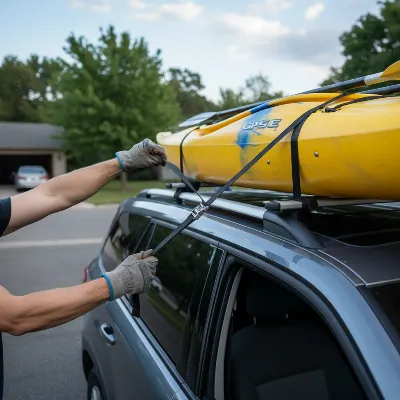 Expert demonstrates securing a kayak to a car roof rack with cam straps.
6. Manage Excess Strap/Rope: Loose strap ends can flap loudly, scratch your vehicle, or even come undone, creating a hazard. Tie off any remaining slack from the cam straps by looping them around the crossbars and securing them with a half hitch or another simple knot. For bow and stern lines, also coil and secure any excess. You can use extra half hitches or even small bungee cords to neatly bundle and secure the loose ends. This extra step prevents aerodynamic drag and ensures nothing gets caught or damaged.
Important Safety Tips and Best Practices
Securing your kayak is only half the battle; maintaining its safety during transit requires ongoing vigilance and adherence to best practices. These tips will help you drive with confidence, knowing your kayak is well-protected.
Firstly, always perform a “shake test” after all straps and lines are secured. Grab both ends of your kayak and gently but firmly try to shake it from side to side and front to back. If there’s any noticeable movement, re-adjust and tighten your straps. The kayak should feel like an extension of your vehicle, firmly affixed.
Secondly, never underestimate the importance of checking your load after a short drive. After about 10-15 minutes of driving, especially at higher speeds or over bumpy roads, pull over to a safe location. Re-check the tension of all your cam straps and bow/stern lines. Straps can sometimes stretch slightly or settle, loosening their grip. A quick re-tighten ensures everything remains secure for the rest of your journey. This simple habit can prevent major issues down the road.
When driving with a kayak on your roof, adjust your driving habits accordingly. Be mindful of the increased height and width, especially when entering garages, drive-thrus, or navigating tight spaces. The added weight and wind resistance can also affect your vehicle’s handling, particularly in crosswinds. Drive at a slightly reduced speed, take turns more gently, and allow for increased braking distances. Avoiding sudden maneuvers will minimize stress on your kayak and securing system.
As mentioned earlier, avoid using ratchet straps for securing kayaks. While they offer immense tightening power, this power is precisely why they are unsuitable. It’s too easy to overtighten and cause irreparable damage to a kayak’s hull, leading to costly repairs or even premature replacement. Stick to cam buckle straps, which provide sufficient grip without the risk of over-compression.
Finally, never leave your kayak on the roof rack for extended periods when not in transit. Prolonged exposure to sun and heat can warp plastic kayaks and degrade the integrity of your straps and rack components. If you need to stop for a meal or a quick errand, locking cam straps or a cable lock can provide peace of mind against theft, but for longer storage, always remove your kayak and store it properly. Consistent care and attention to these details will extend the life of your gear and ensure countless safe kayaking adventures.
Common Mistakes to Avoid
Even with the best intentions, errors in securing a kayak can occur. Being aware of these common pitfalls can help you prevent them and ensure a safer journey.
One of the most frequent mistakes is overtightening the main cam straps. While it might seem logical that tighter is always better, excessive force can deform plastic hulls, leading to “oil-canning” or permanent indentations. For fiberglass or composite kayaks, overtightening can even cause stress cracks. The goal is snug and secure, not crushed.
Another common oversight is failing to secure bow and stern lines. Many paddlers believe that only the main crossbar straps are necessary, especially for shorter trips. However, bow and stern lines are critical for mitigating the effects of wind lift and preventing the kayak from shifting forward or backward during braking or acceleration. Without them, your kayak is vulnerable to dangerous movements, particularly on highways or in windy conditions.
Ignoring loose strap ends is another easily avoidable error. Unsecured webbing can flap violently in the wind, creating distracting noise, potentially damaging your vehicle’s paint, or worse, tangling and loosening the main tie-downs. Always neatly coil and secure any excess strap material using knots or small bungee cords.
Attaching tie-downs to non-structural or plastic vehicle components is a dangerous practice. Bumpers, spoilers, or plastic trim pieces are not designed to withstand the forces exerted by a moving kayak. Always use dedicated anchor points like tow hooks, factory-installed tie-downs, or purpose-built hood/trunk loops that attach directly to the vehicle’s frame.
Finally, failing to check the load after initial driving is a mistake many novices make. Road vibrations, changes in temperature, and the settling of the kayak or straps can cause the initial tension to loosen. A quick stop after 10-15 minutes of driving to re-check and re-tighten everything can be the difference between a safe trip and a disastrous one. By being aware of these common errors, you can proactively avoid them and ensure your kayak transportation is always secure.
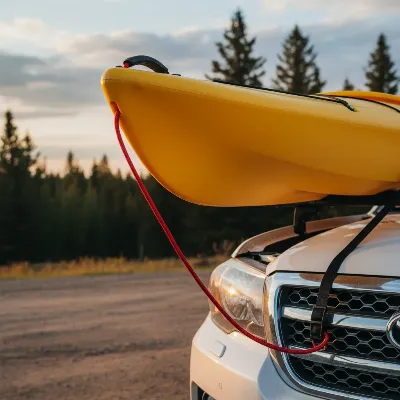 Secure bow and stern lines attached to a kayak and vehicle for safe transport.
Conclusion
Successfully transporting your kayak doesn’t have to be a source of stress. By understanding the essential gear, choosing the right carrier system, and diligently following a few simple yet critical steps, you can ensure your kayak reaches its destination safely and securely every time. The investment in quality equipment and the time spent on proper securing techniques are investments in your safety and the longevity of your gear. From properly positioning your kayak and cinching down cam straps to the crucial addition of bow and stern lines, each step contributes to a robust and reliable transport system. Always double-check your work with a shake test and re-tension after your first few miles on the road. With these DIY insights, you are now equipped to tackle any road trip with confidence, leaving the worries behind and focusing purely on the adventure ahead. What exciting new waterways will you explore now that you can transport your kayak safely and independently?
Common Questions About Kayak Transport
Do I really need bow and stern lines for my kayak?
|
Our Picks for the Best Roof Rack in 2026
As an Amazon Associate I earn from qualifying purchases.
|
||
| Num | Product | Action |
|---|---|---|
| 1 | GarveeLife 46" x 36" Universal Roof Rack Cargo Carrier Basket, 200 Lbs Capacity Rooftop Cargo Rack, Car Top Luggage Holder Basket Heavy Duty for SUVs, Trucks, Vehicles |

|
| 2 | GarveeLife 51 in x 36 in Universal Roof Rack Carrier Basket, 200 LBS Capacity Rooftop Cargo Rack, Car Top Luggage Holder Basket Heavy Duty for SUVs, Trucks, Vehicles |
|
| 3 | KitsPro 260lb Roof Rack Cross Bars for 2011-2021 Jeep Grand Cherokee (ONLY FIT Factory Grooved Side Rails), Matte Black Heavy Duty Aluminum Cargo Crossbar |
|
| 4 | MeeFar Roof Rack Carrier Basket Universal Rooftop 51" X 36" X 5" + Waterproof Bag 15 Cubic Feet (44" 34" 17"), and Cargo Net with Attachment Hooks, Ratchet Straps |
|
| 5 | 64 x 39 x 6 Inch Roof Rack Basket, Heavy Duty 300LB Car Roof Rack Universal Cargo Carrier Rooftop Cargo Basket Steel Luggage Holder for SUV, Truck & Pickup |
|
| 6 | munirater Universal 43.3 inch Black Roof Rack Cross Bar Top Luggage Aluminum Carrier Adjustable Window Frame 2Pcs |
|
| 7 | MaxxHaul Steel Roof Rack Cargo Basket, 46" x 36" x 4.5" Roof Top Carrier, Universal Fit for Cars, SUVs, Vans, and RVs, 150 lb Capacity, Weather-Resistant Easy-Install Cargo Storage (70115) |
|
| 8 | Auto Dynasty Roof Rack Cross Bars Compatible with 2014-2018 Acura MDX, 165lbs Rooftop Cargo Bars Aluminum Anti-Corrosion Bolt-On Roof Rails for Luggage Bike Kayak Racks |
|
| 9 | GarveeLife 51 in x 36 in Universal Roof Rack Basket, 200 LBS Capacity Rooftop Cargo Carrier Basket, Heavy Duty Luggage Holder Rack for SUVs, Trucks, Vehicles |
|
| 10 | MAXXHAUL 50506 64" x 39" x 6" Heavy-Duty Universal Steel Roof Rack , Black |
|
Yes, absolutely. While main crossbar straps secure the kayak to the roof rack, bow and stern lines prevent wind lift at highway speeds and stop the kayak from shifting forward or backward during sudden braking or acceleration. They act as a critical safety backup, especially for longer kayaks or extended trips, ensuring your boat remains stable and doesn’t become a hazard.
How tight should I strap my kayak to the roof rack?
Your kayak should be strapped down until it is snug and secure, without any noticeable movement when you try to shake it. However, avoid overtightening, as this can deform plastic hulls or damage fiberglass kayaks. The goal is firm stability, not compression. Cam straps are ideal for achieving this balance, as they are less prone to overtightening compared to ratchet straps.
Can I use ratchet straps to secure my kayak?
It is strongly recommended not to use ratchet straps for securing kayaks. Ratchet straps provide immense tightening force, which can easily lead to overtightening. This excessive pressure can cause significant and irreparable damage to your kayak’s hull, leading to costly repairs or even compromising its structural integrity. Cam buckle straps are a safer and more appropriate choice.
Is it better to transport a kayak hull-up or hull-down?
Most experts recommend transporting a kayak hull-up (upside down). This position offers several advantages: it protects the delicate hull from road debris and potential damage, prevents water from collecting in the cockpit during rain, and can improve aerodynamics by presenting a flatter surface to the wind. However, ensure proper padding to prevent indentations from the crossbars.
What should I do with loose strap ends?
Loose strap ends from cam buckles or bow/stern lines can flap noisily, potentially scratch your vehicle’s paint, and even come undone, creating a safety hazard. Always coil any excess webbing neatly and secure it tightly using a half hitch knot, or by tucking it under other secured straps. Some paddlers also use small bungee cords to bundle loose ends effectively.
How often should I check my kayak’s security during a long drive?
It’s crucial to check your kayak’s security both before starting your trip and again after the first 10-15 minutes of driving. This initial check allows straps to settle. For longer journeys, it’s good practice to re-check your tie-downs every time you stop for fuel, food, or a rest break. Regular checks ensure that road vibrations or wind haven’t loosened any connections.
Frequently Asked Questions
Do I really need bow and stern lines for my kayak?
Yes, bow and stern lines are essential for kayak transport. They prevent wind lift at highway speeds and stop the kayak from shifting forward or backward during sudden braking or acceleration, acting as a critical safety backup for stability.
How tight should I strap my kayak to the roof rack?
Your kayak should be strapped down until it is snug and secure, with no noticeable movement when shaken. Avoid overtightening, as excessive pressure can deform plastic hulls or damage fiberglass kayaks. Cam buckle straps are recommended for achieving this balance.
Can I use ratchet straps to secure my kayak?
It is strongly recommended not to use ratchet straps for securing kayaks. Their immense tightening force can easily lead to overtightening, causing significant and irreparable damage to your kayak's hull. Cam buckle straps are a safer and more appropriate choice.
Is it better to transport a kayak hull-up or hull-down?
Most experts recommend transporting a kayak hull-up (upside down). This position protects the delicate hull from road debris, prevents water collection in the cockpit during rain, and can improve aerodynamics. Always ensure proper padding to prevent indentations.
What should I do with loose strap ends?
Loose strap ends from cam buckles or bow/stern lines should always be coiled neatly and secured tightly. Use a half hitch knot or tuck them under other secured straps to prevent flapping, vehicle paint damage, or accidental loosening during transit.
How often should I check my kayak's security during a long drive?
It's crucial to check your kayak's security before starting your trip and again after the first 10-15 minutes of driving to allow straps to settle. For longer journeys, re-check tie-downs every time you stop for fuel, food, or a rest break to ensure continued security.
How to Secure Your Kayak to a Roof Rack
Follow these steps to safely and securely transport your kayak on a vehicle roof rack, ensuring stability and preventing damage during transit.
Carefully lift your kayak onto your vehicle's crossbars or specialized carrier system. Ensure it is centered both from front to back and side to side, running parallel to your car. If using J-cradles or stackers, confirm correct seating; if on crossbars, ensure it's hull-up with adequate padding.
You will need at least two cam buckle straps, one for each crossbar. Position the buckle end of the first strap a few inches above and to the side of the front crossbar to avoid paint rub and ensure accessibility. Toss the free end of the strap over the kayak to the other side of your vehicle.
On the opposite side, grab the free end of the strap and loop it underneath the crossbar, inside where it attaches to the vehicle's towers, to prevent sliding. Toss the strap end back over the kayak. Return to the buckle side, loop the strap underneath the crossbar again (inside the tower), and feed the free end into the cam buckle. Repeat for the rear strap.
Gently pull the free end of each strap through its cam buckle to tighten, working back and forth between front and rear. The kayak should be snug and secure without movement, but not so tight that it deforms the hull. Add a single twist to each strap over the kayak to minimize vibration.
Attach one end of a bow line to the front grab handle of your kayak and the other end to a strong, non-plastic anchor point on the front of your vehicle, such as a tow hook. Pull the line snug for stability, avoiding excessive tension. Repeat this process for the stern line at the back of your kayak and vehicle.

The step-by-step instructions were clear, and I appreciate the emphasis on safety checks. However, I found that my older, heavier fishing kayak was still a bit tricky to load into the J-cradles by myself, even with the tips. It’s secure once it’s up there, but getting it on is still a two-person job for me. Good info on the straps though.
I’ve been looking for a better way to transport my recreational kayak, and the breakdown of J-cradles versus saddle systems was super helpful. I ended up going with J-cradles and they work great for my car. The only thing is, I wish there was a bit more detail on specific brands for the cam buckle straps, but overall, very informative.
I used to just throw my kayak on the roof and hope for the best, but after reading about the importance of bow and stern lines, I’m a convert. This guide really emphasized how crucial they are for highway speeds. My kayak feels so much more secure now, even on longer trips. Definitely a game-changer for peace of mind.
This guide saved me a lot of headaches! I was always worried about my kayak shifting on the highway, especially after a friend had a close call. The detailed explanation of how to properly use high-quality cam buckle straps made all the difference. Now I feel confident taking my kayak anywhere without constantly checking my rearview mirror.